
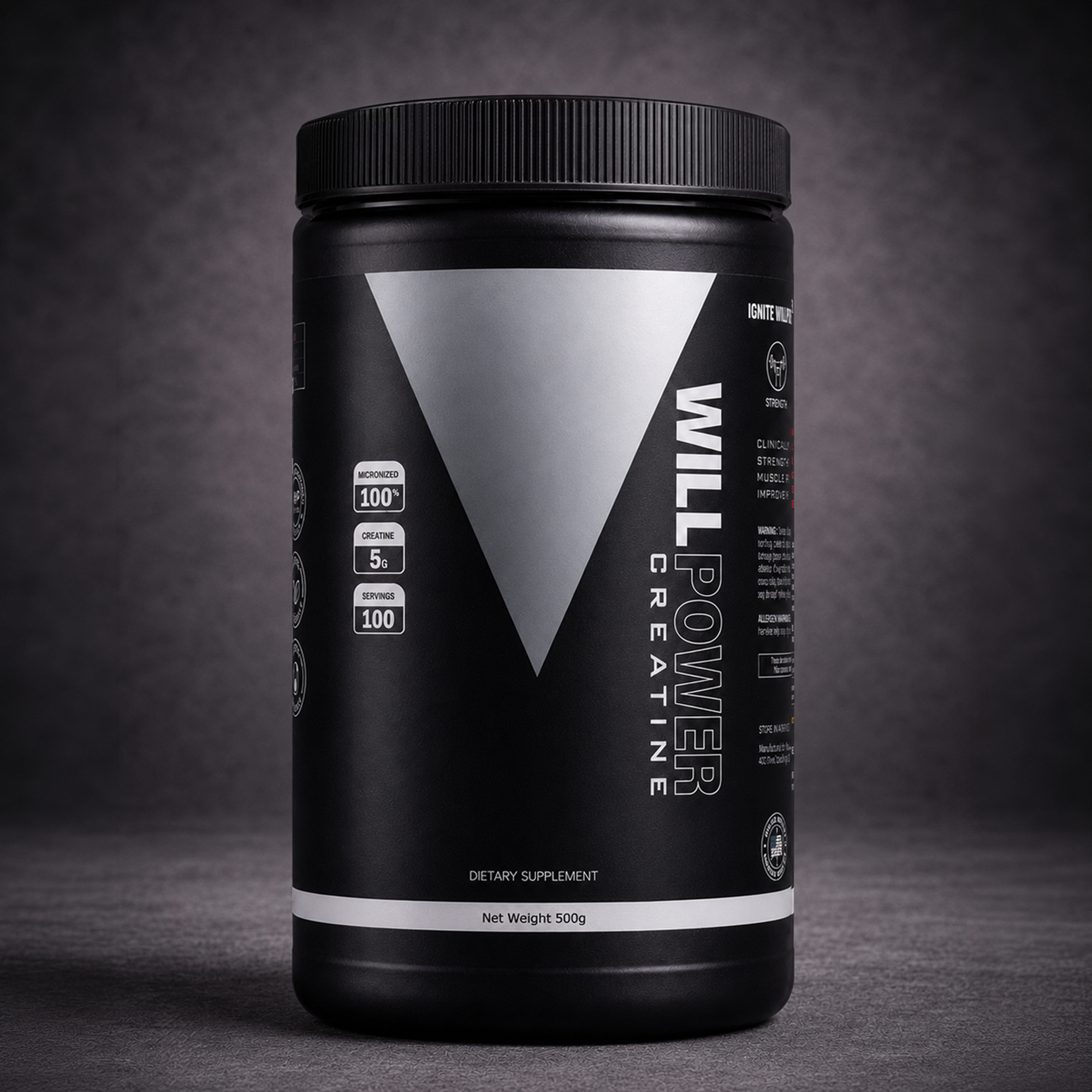

Most serious athletes are already taking creatine. Most are already taking a pre-workout. But they're managing two separate products, two separate scoops, two separate habits to maintain. Getting your full clinical dose of creatine in your pre-workout is one of the simplest, most effective upgrades you can make to your daily training routine.
What Creatine Actually Does (And Why the Dose Matters)
Creatine monohydrate is the most researched performance ingredient in sports nutrition. Decades of peer-reviewed studies support its ability to increase muscle strength and size, improve power output during high-intensity training, enhance muscular endurance, reduce muscle damage between sessions, and support cognitive function under fatigue.
The mechanism is direct. Creatine increases phosphocreatine stores in muscle tissue, which accelerates the regeneration of ATP, your body's primary energy currency during explosive, high-intensity effort. More available ATP means you can push harder, lift heavier, and sustain that output longer before fatigue sets in.
The clinically effective dose is 5 grams per day. Not 2 grams or 3 grams, which is often the dose found in pre-workouts. Five grams, taken consistently, is what the research supports.
Why Most Pre-Workouts Get Creatine Wrong
A lot of pre-workout formulas include creatine on the label, but most of them underdose it. This matters because creatine works through saturation. Your muscles need to reach a threshold concentration before you see the performance benefits. Inconsistent dosing and underdosing both slow that process. A 1-gram inclusion in a pre-workout isn't really doing anything for you, but maybe costing you more for the company being able to claim there is creatine in your product.
If you want creatine to work, you need the full 5-gram clinical dose, taken every day.
The Real Advantage of Having Creatine in Your Pre-Workout
Creatine works through daily saturation, not acute spikes. That means it doesn't matter whether you take it pre-workout, post-workout, or with a meal. What matters is that you take it every single day, without exception.
That's where most people fall short. Consistency requires habit, and habits fail when there are too many steps. A separate creatine tub means remembering a second scoop, a second mixing step, and another thing to run out of and reorder. The more friction in the process, the more days you skip. The more days you skip, the longer it takes to reach saturation. The longer it takes to reach saturation, the less creatine actually does for you.
Adding creatine to your pre-workout removes the friction entirely. Everything you need, dosed correctly, handled before you walk into the gym. You're already committed to taking your pre-workout. That commitment now carries your creatine with it.
Why Consistency Beats Timing Every Time
There's a persistent debate about when to take creatine. Pre-workout or post-workout, fasted or fed. The research does not support strong conclusions either way. What the research does support is this: daily intake, sustained over weeks, is what produces results.
Creatine takes time. In the first one to two weeks of consistent daily use at 5 grams, your muscles are building phosphocreatine stores. By weeks three and four, you begin reaching saturation. That's when performance improvements become measurable. Strength goes up. Power output improves. Recovery between sets shortens.
Skip three days and you haven't lost everything. But skip enough days over enough weeks, and you're never fully saturated. You're getting a fraction of the benefit while taking the product.
Attaching creatine to your pre-workout habit is a system, and systems beat motivation. You don't need to remember creatine as its own task. It's just part of training prep.
What to Look For in a Pre-Workout With Creatine
Not all formulas are built the same. When you're evaluating a pre-workout that includes creatine, these are the things that actually matter:
- 5 grams of creatine monohydrate per serving. This is the clinical dose.
- Full label transparency. Every ingredient and dose should be listed individually. Proprietary blends exist to obscure underdosing. If the label won't tell you what's in it, that's the answer.
- Creatine monohydrate specifically. The supplement industry has introduced many newer creatine forms. None has consistently outperformed monohydrate in peer-reviewed research. Look for Monohydrate.
- A complete pre-workout formula. Creatine should sit alongside efficacious doses of the other performance ingredients. Caffeine for energy and focus, citrulline malate for blood flow and endurance, beta-alanine for buffering fatigue. All of them need to be dosed at levels the research actually supports.
Willpower Pro Pre-Workout Includes 5 Grams of Creatine Monohydrate
Willpower Pro Pre-Workout is built with 15 ingredients, every one of them dosed at performance levels. That includes 5 grams of creatine monohydrate per serving.
One scoop handles your pre-workout and your daily creatine.
The Bottom Line
Creatine works. The research on that is settled. But creatine only works if you take it consistently, at the right dose, every day. A pre-workout that includes a full 5-gram dose of creatine monohydrate makes that consistency automatic. One habit, one product, everything accounted for.
If you're already taking a pre-workout, you're already halfway there. Make sure creatine is in it. Make sure it's dosed correctly. Then show up and do the work.
The Standard Is Rising. Let's Get To Work.