
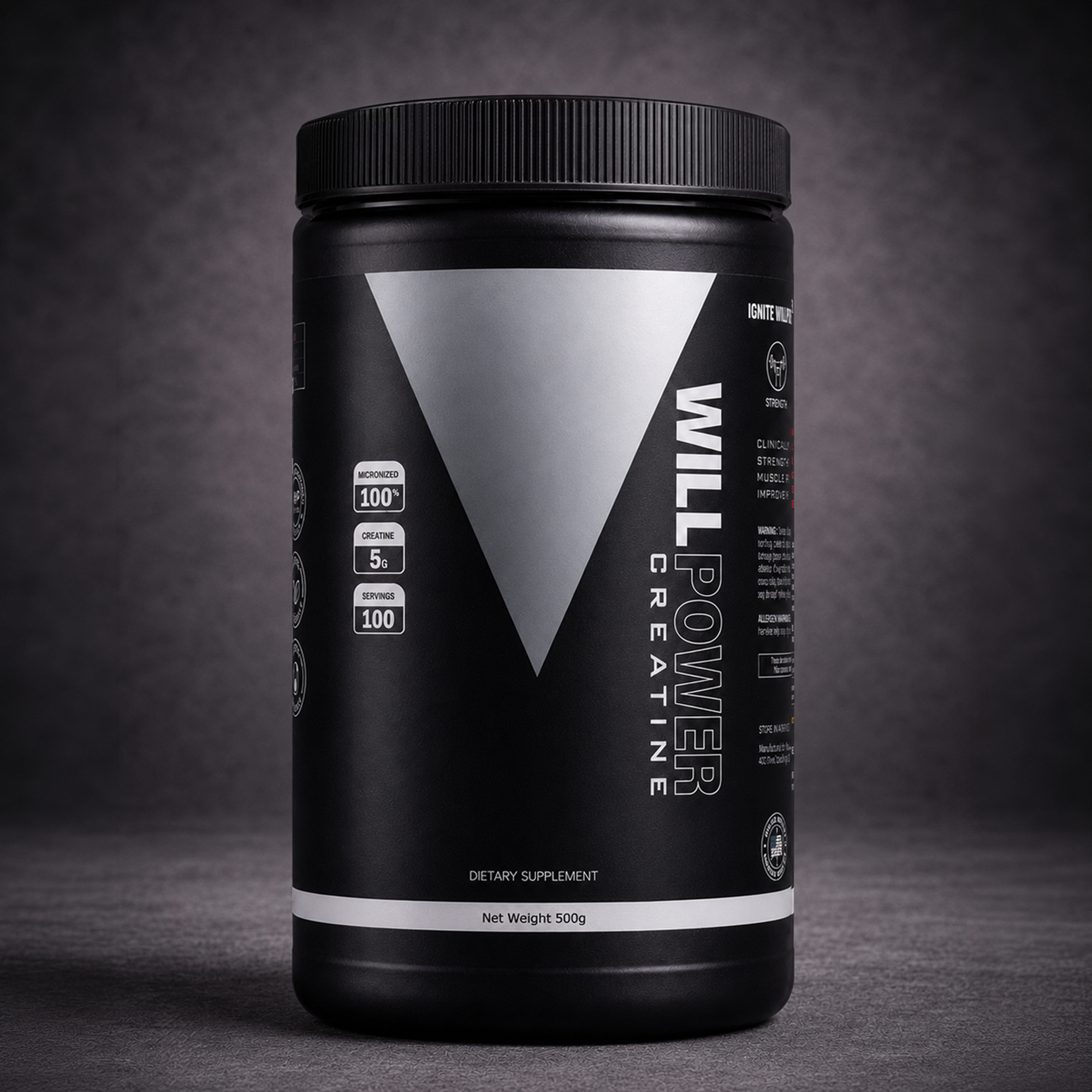

Creatine is one of the most researched compounds in sports nutrition. Decades of peer-reviewed studies support its effects on strength, muscle growth, recovery, and cognitive function. Yet most people either take it without understanding why, or avoid it based on myths that the research has long since debunked.
This guide covers what creatine actually does, how it works, what the science shows, and how to use it effectively.
What Is Creatine?
Creatine is a naturally occurring compound your body synthesizes from three amino acids: arginine, glycine, and methionine. It's also found in whole foods, primarily red meat and fish.
The challenge is that dietary intake alone rarely saturates muscle creatine stores to the level that meaningfully impacts performance. Supplementation closes that gap consistently and efficiently.
How Creatine Works
Your body runs on ATP (adenosine triphosphate), the primary energy currency for high-intensity muscular effort. During intense exercise, ATP is depleted faster than your body can regenerate it. That depletion is a primary driver of fatigue.
Creatine is stored in muscle tissue as phosphocreatine. When ATP runs low, phosphocreatine rapidly donates a phosphate group to regenerate it. Higher phosphocreatine stores mean your body can sustain high-intensity output longer before fatigue sets in.
The result: more total work capacity, better power output, and improved training quality over time.
What the Research Shows
Strength increases can occur within two weeks.
A controlled study found that creatine monohydrate increased muscular strength in as little as two weeks during a progressive resistance training program. Researchers also noted that creatine appeared to enable greater training intensity, which may drive increased protein turnover and accelerate long-term muscle adaptation.
Creatine monohydrate outperforms newer formulations.
The supplement industry has introduced multiple alternatives including creatine HCL, Kre-Alkalyn, and buffered creatine, each positioned as an improvement on monohydrate. A 2024 study comparing creatine monohydrate directly to creatine hydrochloride found that both forms improved strength, hypertrophy, and hormonal responses, but creatine HCL produced no additional benefit over monohydrate. The evidence consistently supports monohydrate as the standard.
Body composition responds, particularly in early supplementation.
Research found that a short creatine loading period increased lean body mass, with notable effects in female participants. The same study noted that a daily maintenance dose of 5g may be necessary to sustain lean body mass growth over time.
The Full Scope of Creatine's Effects
The performance benefits are well established, but creatine's effects extend beyond the gym.
Muscular performance
- Increases strength and power output
- Improves performance in high-intensity, short-duration efforts
- Enhances muscular endurance
- Reduces muscle damage and soreness between sessions
- Supports lean muscle growth in combination with resistance training
Cognitive function
Creatine supports brain energy metabolism. Research suggests it may improve memory, focus, and mental performance, particularly under conditions of fatigue, sleep deprivation, or mental stress. The brain is an energy-intensive organ, and creatine plays a role in how efficiently it produces and uses that energy.
Healthy aging
As people age, maintaining muscle mass becomes increasingly difficult and increasingly important. Creatine supports mitochondrial health, helps protect against age-related muscle loss, and may help regulate glucose metabolism. The evidence for creatine as a longevity-supporting supplement is growing.
Creatine Monohydrate vs. Other Forms
The case for monohydrate is straightforward. It is the most studied, most validated form available. Competing forms have consistently failed to outperform it in head-to-head research while typically costing more.
Micronized creatine monohydrate is worth noting as a practical upgrade. The micronization process breaks creatine into finer particles that dissolve more completely in liquid. Standard creatine powder often leaves undissolved residue, which can cause stomach discomfort and means you may not be absorbing the full dose. Micronized creatine largely eliminates that problem.
The active compound is identical. The difference is solubility and tolerability.
How to Use Creatine
Creatine Dose: 5 grams daily for men. Research supports 3 grams daily for women as an effective dose. These are the clinically validated amounts for saturating muscle stores and sustaining performance benefits.
Loading: A loading phase, typically 20 grams per day for 5 to 7 days, will saturate muscle stores faster. It is not required. Daily supplementation at 5 grams reaches full saturation within 3 to 4 weeks. Either approach works. Loading just accelerates the timeline.
Timing: Pre-workout and post-workout both show benefits in the research. Consistency matters more than timing. Taking creatine at the same time each day, whenever that fits your routine, is the most practical approach.
Cycling: There is no evidence that cycling creatine on and off improves outcomes. Creatine works through sustained saturation. Stopping supplementation gradually depletes muscle stores over several weeks.
Mixing: Creatine monohydrate is flavorless and mixes into water, protein shakes, juice, or any liquid. Micronized creatine dissolves more completely than standard powder.
Common Creatine Questions
Does creatine cause bloating? Standard creatine powder that does not fully dissolve can cause gastrointestinal discomfort. Micronized creatine, which dissolves completely, largely eliminates this issue for most people.
Is creatine safe for long-term use?
Yes. Creatine is one of the most extensively safety-tested supplements available. Long-term studies have not demonstrated adverse effects in healthy adults.Does creatine cause water retention?
Creatine draws water into muscle cells, which is intracellular fluid rather than subcutaneous retention. This contributes to the initial weight increase some people notice and is part of the mechanism behind improved cellular hydration and performance.Is creatine only for athletes?
No. Given its effects on muscle preservation, cognitive function, and healthy aging, creatine is relevant for any active adult, not just competitive athletes or advanced lifters.Creatine Summary
Creatine increases phosphocreatine stores in muscle, enabling faster ATP regeneration during high-intensity effort. The downstream effects include improved strength, power output, muscular endurance, lean body mass, recovery, and cognitive performance. The evidence base is extensive and consistent.
Creatine monohydrate at 5 grams daily is the standard, evidence-supported protocol. No loading phase is required. No cycling is necessary. Results build through sustained daily use over weeks and months.
It is not a shortcut. It is a well-researched tool that supports the work you are already putting in.